
Before You Buy
Rescreen or Replace the Whole Cage?
We are a rescreening company. We do not build new pool enclosures, so every time we tell a homeowner their cage should be replaced rather than repaired, we are talking ourselves out of a job. That is worth stating up front, because it is also why this article is useful.
The honest position is that repair wins in the large majority of cases, and there are four specific findings where it stops making sense.
Why repair usually wins
Aluminium frames outlast screen mesh by decades when they are not corroded through. A well-built cage frame has a service life somewhere in the twenty to forty year range. The mesh gives you five to eight. That mismatch means most cages get rescreened three or four times over their life, and that is the system working correctly rather than a sign of a problem.
| Item | Figure | Notes |
|---|---|---|
| Full rescreen, one story | $1,100 – $2,000 | Every 5–8 years |
| Full rescreen, two story | $1,900 – $3,400 | Every 5–8 years |
| Fastener and hardware work | $110 – $280 | Once or twice per frame life |
| Upright or beam replaced | $260 – $700 each | As needed |
| Re-anchoring | $110 – $340 | Once per frame life |
| New enclosure (aluminium contractor) | $9,000 – $28,000+ | Once per 25–40 years |
The gap between those last two rows is why repair is nearly always the right answer. A cage needing two uprights replaced and a full rescreen might come to $3,200. That is a substantial invoice and it is roughly a fifth of what a new enclosure costs.
Finding one: most uprights are corroded through
Individual corroded members are a repair. Corrosion across the majority of the structure is not, because you are effectively rebuilding it member by member at repair prices with no engineering behind the result.
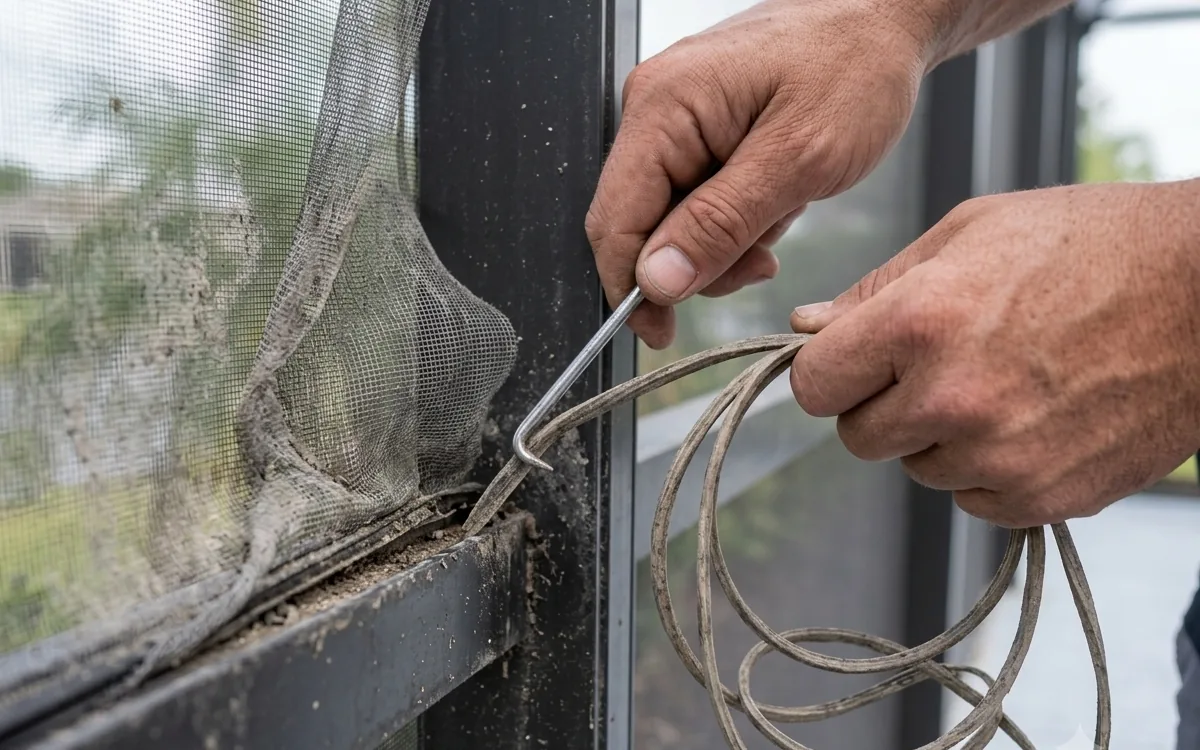
The threshold is judgement rather than a formula, but roughly: if more than about a third of the uprights need replacing, the economics have tipped. At that point you are paying most of a replacement cost for a structure that is still the original design and still ageing everywhere you have not touched.
Finding two: the footer has failed
The footer is the concrete the cage is anchored into. If it has cracked, spalled or subsided, no amount of work to the aluminium fixes anything, because the structure has nothing sound to hold onto.
This is uncommon but it is decisive. Re-anchoring into failed concrete does not work, and a cage that is not properly anchored is not resisting wind uplift regardless of how good the frame above it looks.
Finding three: it was undersized to begin with
Some cages, particularly pre-1994, were built lighter than we would build them now. If the members are undersized for the span and the structure visibly deflects in ordinary wind, repairs address symptoms rather than the cause.
You can rescreen it and it will look fine. It will still be a structure that was not engineered for the loads this region produces, and that will not change no matter how much aluminium you replace.
Finding four: repeated repairs are not holding
If the same members keep failing after being fixed, or panels keep going slack across the structure rather than in one opening, the frame has passed the point where localised repair works. Fixing the same thing a third time is a signal, not bad luck.
What does not mean replacement
Homeowners get told a cage needs replacing far more often than it actually does. None of the following, on their own, are replacement findings.
- All the mesh has failed. That is a rescreen. Mesh failing everywhere at once is normal and expected on its schedule.
- The cage is thirty or forty years old. Age alone is not a finding. Frames of that vintage are frequently sound; it is the fasteners that have gone.
- Several uprights show corrosion. Individual members are replaceable at $260 to $700 each.
- The door is beyond repair. A door is $185 to $360. It has nothing to do with the structure.
- It looks bad. Chalky mesh and oxidised aluminium are cosmetic. Neither says anything about structural condition.
How to get an honest answer
There is an obvious conflict of interest in this trade running in both directions. A rescreening company has a reason to tell you the frame is fine. An enclosure builder has a reason to tell you it is not.
The way through it is to ask for specifics. Which members are compromised, and where. What is the anchor condition. Is the footer sound. What would the repair cost be, itemised. Anyone who cannot answer those in detail is giving you an opinion rather than an assessment.
And if the answer genuinely is replacement, you want a Florida-licensed aluminium contractor who will engineer and permit the structure properly. We will tell you when that is the case and point you toward people who do it well, because a homeowner we sent elsewhere honestly is a homeowner who calls us in seven years to rescreen their new cage.
Questions
Related questions
Generally $9,000 to $28,000 or more depending on size, height and specification, from a licensed aluminium contractor. That figure is why repair wins in most cases: even a substantial repair plus a full rescreen is typically a fifth of it.
Twenty to forty years for a well-built structure that is not corroded through, against five to eight years for the mesh. Most cages get rescreened three or four times over the life of the frame, which is the system working as intended.
Not on age alone. Plenty of forty-year-old Tampa cages have structurally sound aluminium and only need fasteners and anchors addressed. What matters is the condition of the members, the anchors and the footer, not the year it went up.
Someone with the opposite conflict of interest to whoever gave you the first one. If a rescreening company says the frame is fine, ask an aluminium contractor. If a builder says it needs replacing, ask a rescreening company. Where they agree, you have your answer.
Yes, and it is a genuine middle option. Replacing one badly deteriorated section or elevation while keeping the rest is sometimes the right call, particularly where damage is concentrated on one exposure. It needs an aluminium contractor rather than a rescreening company.
A sound one is generally regarded as an asset in Florida. A visibly failing one is a negotiating point for buyers, and a structure that clearly needs replacing can affect a sale meaningfully. Rescreening before listing is usually worth it; replacing rarely pays back fully.
Depends on your policy and the cause. Named-storm damage is often covered subject to a separate screen enclosure deductible and limits. Age-related deterioration is not covered by any policy — that is maintenance, and carriers are consistent about the distinction.
Yes, and mesh is the cheapest part of the structure, so a rescreen is not a wasted investment if replacement comes several years later. What is genuinely wasteful is rescreening a cage you already know needs replacing within a year or two.
Keep reading
More pool cage guides
Find out what your cage costs
We come out, count every panel including the roof, check the frame, and hand you a flat written price. No deposit, no obligation.
Mon–Sat 7:00am–7:00pm · Licensed & insured · Hillsborough County & south Pasco