
Structure
What Florida Wind Code Means for Your Pool Cage
Homeowners generally discover their pool cage has a wind rating at the worst possible moment, which is after a named storm. It is a considerably more useful thing to understand while the weather is calm, because it changes what you should be checking and what you should be repairing.
This is a plain-language overview rather than an engineering document. For anything involving permits, structural certification or an insurance dispute, a Florida-licensed engineer is who you want, not a rescreening company.
The 2002 dividing line
Florida’s statewide building code took effect in 2002, and it was a significant tightening for screen enclosures — largely a response to what Hurricane Andrew had demonstrated a decade earlier. Cages built after it are generally engineered to higher design wind speeds, with heavier members, more substantial anchoring and better-specified connections.
This is why cage age turns out to be one of the more useful things we can know before quoting. An enclosure built in 1985 in Carrollwood and one built in 2015 in Wesley Chapel are different structures with different failure modes, even though they look broadly similar from the deck.
| Item | Figure | Notes |
|---|---|---|
| Pre-1994 cages | Lightest construction | Fasteners and anchors first |
| 1994 – 2002 | Transitional | Varies considerably |
| Post-2002 | Modern code | Mesh fails, frame usually holds |
| Post-2010 | Current standards | Frame findings are rare |
| Any age, waterfront | Salt overrides age | Anchors are the weak point |
| Any age, unpermitted work | Unknown | Worth an engineer’s look |
Screen releasing is the design working
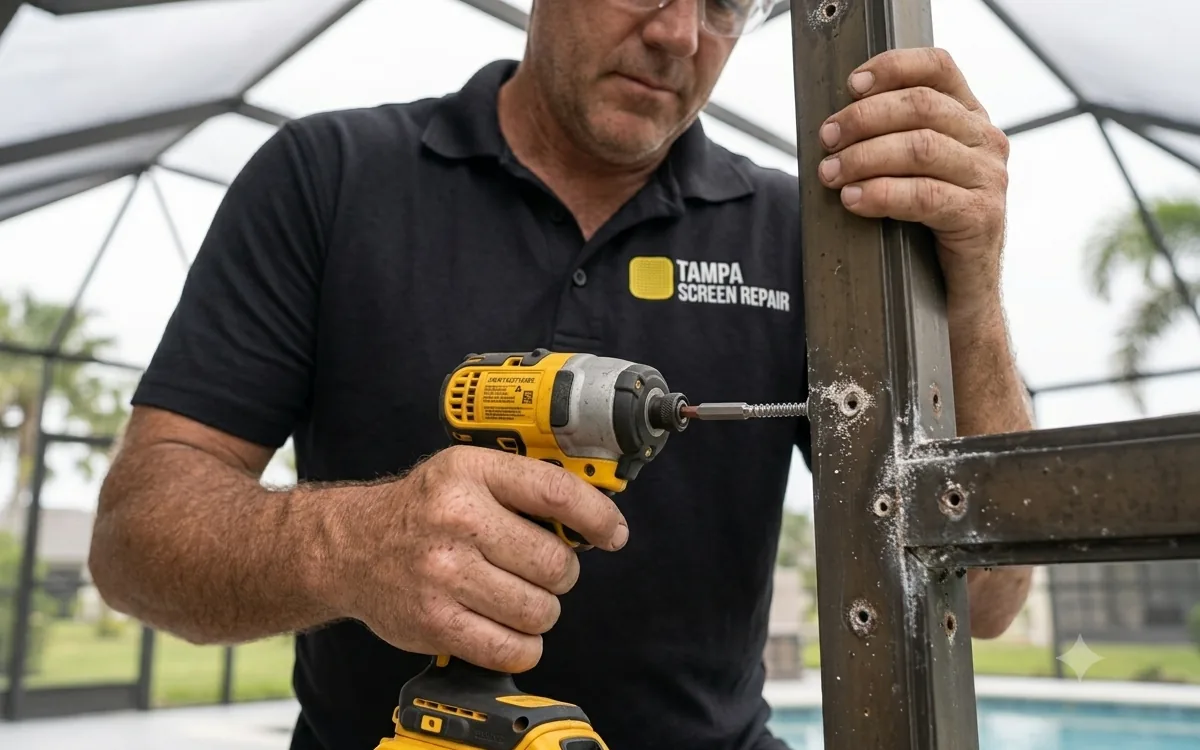
The single most useful thing to understand about a pool cage in a storm: the mesh is meant to go first.
Screen enclosures are engineered to fail in sequence. Under high wind load the mesh releases from its channels, which relieves pressure before that force transfers into the beams, the anchors and ultimately your roofline. A cage that lost eight panels absorbed energy that would otherwise have gone somewhere far more expensive to repair.
So a stripped cage after a storm is frustrating to look at and is not evidence of a defect. What matters is whether the aluminium and the anchors came through it, because those are what determine whether the structure survives the next one.
What this changes about repairs
On a pre-2002 cage, the frame check matters far more than on a modern one. Fasteners and anchors from that era are typically well past their service life, and corrosion spreading from screw points is the usual finding. Rescreening over that is money spent twice, because mesh tensioned into a channel that cannot hold it goes slack within a season.
On a post-2002 cage the frame usually passes, and the job is a straight rescreen. We still check — it takes a few minutes and it is free — but the overwhelming majority of Riverview, Lithia and Wesley Chapel cages need no aluminium work at all.
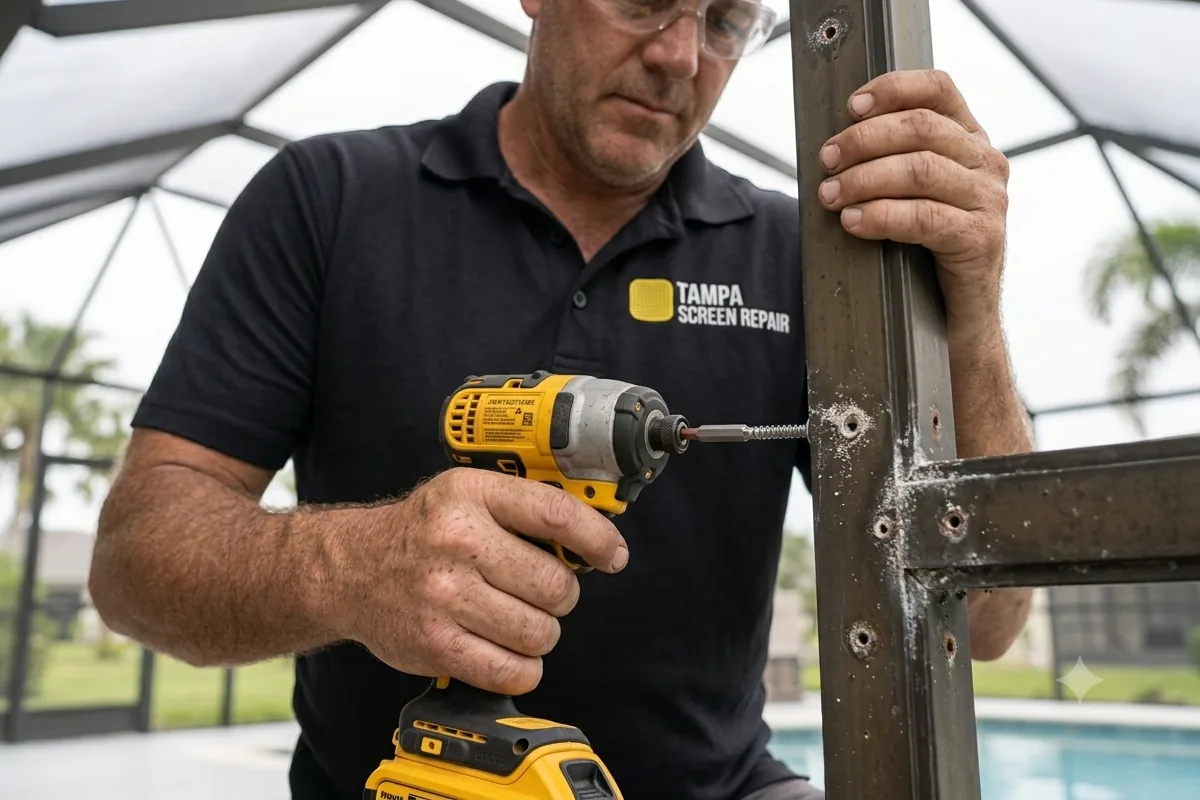
Repairs and code compliance
Replacing screen mesh is maintenance, not construction, and does not trigger code review. Replacing individual aluminium members like-for-like is repair. Where it gets more complicated is substantially rebuilding or enlarging a structure, which can bring the whole enclosure into scope for current code and permitting.
This is one of the reasons we are honest with customers about the point where repair stops making sense. Repeatedly patching a pre-code cage can quietly become a rebuild that was never engineered or permitted as one, and that is a problem you inherit at resale or at claim time.
What to do before hurricane season
- Have anchors and fasteners checked — the highest-value preventive step by a wide margin, and free with any panel count.
- Clear the cage out completely — furniture inside a cage becomes a projectile that destroys panels from the inside, where the mesh has no give.
- Trim overhanging limbs — the leading cause of roof panel damage on wooded lots, and no mesh grade survives a branch.
- Do not remove screen panels — people ask about this every year. It does not help and it removes the controlled failure mechanism the structure relies on.
- Do not tarp the cage — a tarp turns a screen structure into a solid sail, which is the opposite of what you want.
If you genuinely need to know
For a definitive answer on what your specific cage was engineered to withstand, you need the original permit and engineering documents, which your county building department may hold, or an inspection by a Florida-licensed structural engineer. We can tell you the condition of your aluminium and how it compares to others of its era. We cannot certify a wind rating and neither can anyone else without doing the engineering.
Questions
Related questions
If it was permitted, it was engineered to the code in force at the time. Post-2002 structures are generally rated substantially higher than earlier ones. The specific figure lives in the original permit documents, which your county building department may still hold.
Usually a difference in cage age, orientation and exposure rather than in build quality. Wind loading varies enormously over short distances depending on surrounding structures and tree cover. A cage that lost panels may simply have taken more load.
No. It is a persistent piece of neighbourhood advice and it does not help. The mesh releasing under load is the controlled failure mechanism that protects the frame and your roofline. Removing it in advance takes that away and creates nothing useful.
No. Replacing mesh is maintenance rather than construction, and like-for-like replacement of individual aluminium members is repair. Substantially rebuilding or enlarging an enclosure is a different matter and can bring it into scope for current code.
Sometimes, through anchor upgrades and member reinforcement, but it is engineering work rather than rescreening work and it is rarely economical. Past a certain point a new enclosure built to current standards costs less than retrofitting an old one.
They are the part most often overlooked and most often decisive. Anchors resist uplift on the whole structure, so corroded or pulled anchors compromise a cage regardless of how sound the aluminium above them is. Re-anchoring is also one of the cheaper structural repairs.
It can affect both coverage and settlement, since some Florida carriers treat screen enclosures separately with their own deductible and limits, and depreciation on an older structure reduces payout. Read your declarations page for screen enclosure language before you need it.
No, and nobody honestly can. Too much depends on the specific storm, your exposure and surrounding structures. What we can tell you is the condition of your anchors, fasteners and members, and how that compares to other cages of the same era.
Keep reading
More pool cage guides
Find out what your cage costs
We come out, count every panel including the roof, check the frame, and hand you a flat written price. No deposit, no obligation.
Mon–Sat 7:00am–7:00pm · Licensed & insured · Hillsborough County & south Pasco