
Diagnosis
Roof Screens vs. Wall Panels: Which Fails First
On virtually every Tampa pool cage we inspect that has never had a full rescreen, the roof panels are in visibly worse condition than the walls. Not slightly worse. Often it is roof screens that tear at a fingertip sitting directly above wall panels with three good seasons left in them.
This is not bad luck or a manufacturing issue. It is geometry, and once you understand it you will know more about your own cage than most of the people quoting on it.
The sun does not move the way you think it does
A wall panel faces one direction. As the sun tracks across the sky, that wall gets direct exposure for part of the day and indirect light for the rest. The south and west walls get more than the north and east, which is why they always age faster, but even the worst wall gets a break.
A roof panel faces up. From mid-morning to late afternoon the sun is on it, every day, all year, with no relief and no angle of incidence working in its favour. The practical result is roughly double the total UV dose over the same period.
| Item | Figure | Notes |
|---|---|---|
| Roof and gable panels | 4 – 6 years | Full-day direct UV |
| South and west walls | 5 – 7 years | Heavy afternoon exposure |
| North and east walls | 7 – 9 years | Partial exposure only |
| Shaded walls under an eave | 8 – 10 years | Minimal direct UV |
| Kick plate row | Damage-driven | Fails from abuse, not sun |
| Waterfront, any orientation | Subtract 1 – 2 years | Salt attacks hardware too |
How to check your own roof panels
Stand underneath the cage and look straight up, ideally with the sun behind the panels rather than in your eyes. You are looking for a difference in how the mesh reads.
Sound screen looks like an even, dark, consistent field. Aged screen goes translucent and blotchy, because the weave has opened up as the strands degrade and shrink away from each other. Once you have seen both, the difference is unmistakable and you can assess a cage from the deck in about ten seconds.
Why this matters when you are comparing quotes
Roof panels are the most awkward openings on the structure to reach and the most expensive to replace — $55 to $95 each against $35 to $65 for a wall panel. On a cage where roof panels are a third of the total count, they can be nearly half the cost of the job.
That combination makes them the single easiest place to make a quote look better. A rescreen priced on wall panels only can come in thirty percent below a complete one, and unless you know your own roof count you will not spot it. You will spot it eighteen months later when the roof panels finally go and you are paying for a second mobilisation.
So ask directly: how many roof panels are in this price. A company that itemises them without hesitating is pricing carefully. A vague answer usually means a vague number.
Do not upgrade the mesh up there
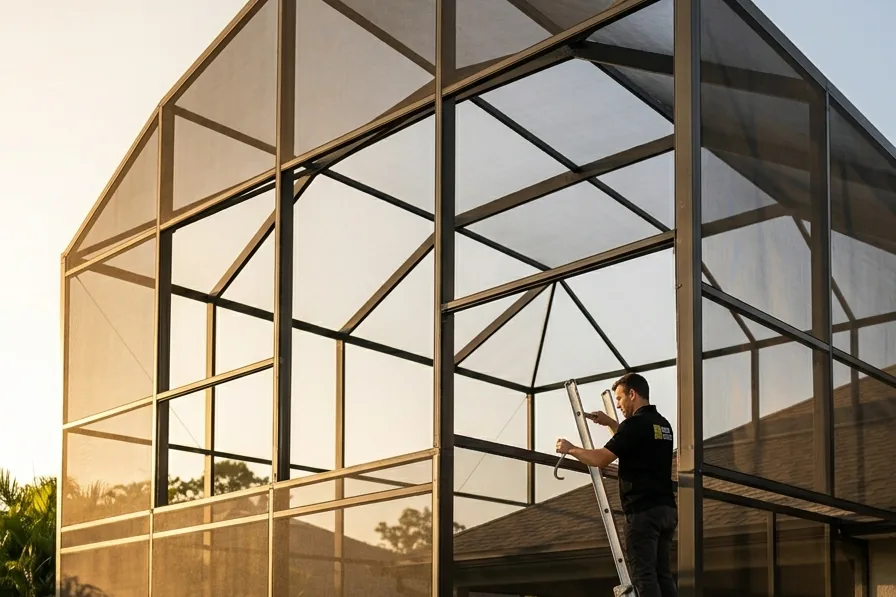
A reasonable-sounding conclusion from all this is that roof panels should get a tougher mesh. They should not, and we will actively talk customers out of it.
The limiting factor on a roof panel is ultraviolet degradation, not tear strength. Pet-resistant polyester is engineered to resist claws and impact, which is a problem roof panels never face. It costs meaningfully more and buys you very little extra service life in that position.
Standard charcoal 18×14 on the roof, and spend the upgrade budget on the kick plate row where physical abuse actually happens. That is where a tougher product earns its cost.
Tree canopy changes the calculation
Under heavy oak cover — common in Valrico, Temple Terrace, older Carrollwood and much of Lutz — falling limbs overtake UV as the leading cause of roof panel failure. Shade extends the mesh life while branches shorten it, and on balance those cages need roof work about as often, just for a different reason.
No mesh grade survives a branch, so the only genuine prevention is trimming what overhangs the enclosure. It is worth doing before a rescreen rather than after.
The practical takeaway
Check your roof panels first, not last. If they fail the fingertip test and your walls do not, doing the roof now and the walls in two or three years is a perfectly sensible way to spread the cost. The new roof mesh will read noticeably darker than the walls for about a year, and then it will even out.
Questions
Related questions
$55 to $95 per panel. Doing all roof panels on a single-story cage typically runs $400 to $900, and $700 to $1,300 on a two-story cage because of the staging required. It is a legitimate standalone job when the walls still have life in them.
Yes, and it is often the smart sequence since the roof fails first anyway. The one caveat is appearance: new charcoal mesh reads noticeably darker than sun-faded mesh for about a year, so the contrast between new roof and older walls will be visible.
Access. Everything overhead needs ladders or staging, takes longer per opening, and carries more risk for the installer. On a steeply pitched two-story cage the roof panels are the most expensive openings on the whole structure.
Broadly yes, since they sit at a similar exposure. They are priced in the same band at $55 to $95. Gables are also the panels most often missed on a self-count, so make sure yours are in whatever number you are comparing quotes against.
No, use the same charcoal as the rest of the cage. Colour consistency matters visually and charcoal performs best overhead anyway, since darker mesh absorbs light rather than scattering it and reads more transparent from underneath.
No, and it is not designed to be. A pool cage roof is screen, so rain passes through it. If you want a covered dry area that is a different structure entirely — a roofed lanai or a solid patio cover, which is aluminium contractor work rather than rescreening.
Unusual but not impossible. It generally means the roof has been replaced more recently than the walls, or the cage sits under heavy shade that has protected the overhead panels. Either way, replace what has actually failed rather than assuming the standard pattern.
Ask them to itemise the roof count separately on the written quote. Any company pricing carefully will do this without argument, because it is how they count internally anyway. Reluctance to break it out is itself an answer.
Keep reading
More pool cage guides
Find out what your cage costs
We come out, count every panel including the roof, check the frame, and hand you a flat written price. No deposit, no obligation.
Mon–Sat 7:00am–7:00pm · Licensed & insured · Hillsborough County & south Pasco