
Maintenance
A Realistic Pool Cage Maintenance Schedule
Most pool cage maintenance advice on the internet is written by people who have never rescreened one. It tends to be long, generic, and full of tasks that do essentially nothing for the lifespan of the structure.
Here is the version from people who fix these for a living, including the parts that are honestly not worth your Saturday.
Twice a year: rinse the frame
A garden hose, from the top down, working around the whole structure. Fifteen minutes. The point is not appearance, it is removing accumulated salt, pollen and grit from the channels and fastener points where corrosion starts.
On waterfront property in Apollo Beach or South Tampa this is the single most valuable thing on this list, and quarterly is better than twice a year. Salt sitting in a channel around a steel fastener is what starts the galvanic corrosion that eventually costs you an upright.
No pressure washer. Pressure washing screen mesh stretches and damages it, and driving water into fastener points does the opposite of what you want. Plain hose pressure is correct.
Once a year: the five-minute frame check
This is the item that actually saves money, and almost nobody does it.
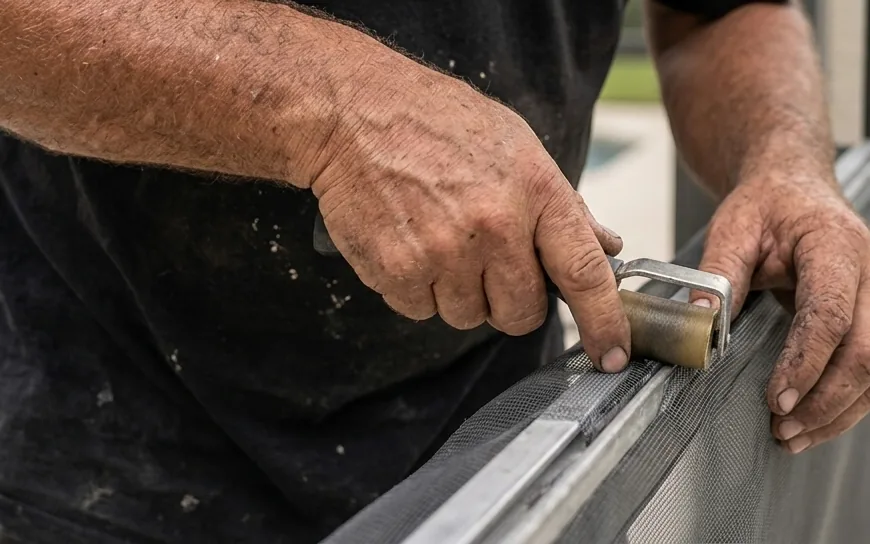
- Push each upright at chest height. It should feel solid. Springy or flexing means the connections need looking at.
- Look at the base of every upright. White powdery residue, staining, or a visible gap around the anchor is a finding worth acting on.
- Sight along the top beam from a corner. A dip means a span has lost support somewhere.
- Press a panel near each corner. If the frame moves rather than the mesh, that joint has opened.
- Work the cage door through its full travel. Dragging, jumping or failing to latch means rollers or track.
Once a year: the fingertip test
Press firmly on the mesh in a few places on each wall, and on a roof panel if you can reach one from a ladder without climbing on the structure.
Sound screen flexes and springs back. Aged screen feels brittle and may split. This is how you find out whether you are two years from a rescreen or five, which is worth knowing before a panel tears and forces the decision on someone else’s timeline.
As needed: keep vegetation off it
Anything overhanging the cage will eventually come through the roof panels, and no mesh grade survives a branch. Anything growing against it — vines especially — holds moisture against the aluminium and accelerates corrosion at exactly the points you least want it.
Trimming what overhangs the enclosure is the only genuine prevention for roof panel impact damage. On wooded lots in Valrico, Temple Terrace and Lutz it is worth doing annually.
Before every named storm
Clear everything out of the cage. Furniture, planters, pool equipment, the lot. Items inside a cage become projectiles that destroy panels from the inside, where the mesh has no give and no controlled release. This is the most common avoidable storm damage we repair.
Do not remove screen panels and do not tarp the structure. Both come up every hurricane season and both make things worse. The mesh releasing under load is the mechanism protecting your frame, and a tarp turns a screen enclosure into a solid sail.
What is not worth your time
- Scrubbing the mesh. Aesthetic only, and vigorous scrubbing shortens screen life by working the strands. A hose rinse is plenty.
- Pressure washing anything on the cage. Stretches mesh, damages spline seating, drives water into fasteners.
- Screen sealants and protectant sprays. No credible evidence they extend life. UV degradation happens within the fibre, not on its surface.
- Lubricating door tracks with oil. It attracts grit, which is abrasive. Clean the track instead; a dry lubricant if anything.
- Replacing mesh on a schedule. Replace it when it fails the fingertip test, not on a calendar. Cages vary by years depending on exposure.
A realistic annual rhythm
| Item | Figure | Notes |
|---|---|---|
| Spring | Hose the frame down | 15 minutes |
| Spring | Five-minute frame check | 5 minutes |
| Spring | Fingertip test on each wall | 5 minutes |
| Early summer | Trim overhanging limbs | As needed |
| Before each storm | Empty the cage completely | 30 minutes |
| Autumn | Second frame rinse | 15 minutes |
That is roughly ninety minutes a year plus storm prep. It will not make your mesh last longer — UV decides that and nothing you do changes it much. What it does is catch frame problems while they are $150 fastener jobs rather than $600 member replacements, and make sure your anchors are sound before the weather tests them.
Questions
Related questions
Not the screen, and not the frame at pressure. Pressure washing stretches and damages mesh, disturbs spline seating, and drives water into fastener points where corrosion starts. A garden hose from the top down does everything useful without the damage.
There is no credible evidence they meaningfully extend mesh life. UV degradation happens within the fibre rather than on its surface, so a surface coating does not address the actual failure mechanism. Money is better spent on the frame check.
Twice a year inland, quarterly on waterfront property. Salt is the driver, so Apollo Beach, South Tampa and canal-front cages benefit far more from frequent rinsing than inland Brandon or Riverview cages do.
The annual frame check, particularly the anchor points. It costs five minutes and catches problems while they are inexpensive fastener repairs rather than member replacements, and anchor condition is what determines storm survival.
No, replace it when it fails the fingertip test. Cage exposure varies enormously, so calendar-based replacement means either paying early or being caught out late. Sound mesh flexes and returns; aged mesh feels brittle and splits.
Cosmetic in almost every case. A hose rinse and mild soap handles it. Persistent heavy mildew usually indicates poor airflow or vegetation growing against that section, and the vegetation is worth addressing for corrosion reasons anyway.
Work it through its full travel once a year and keep the bottom track clear of grit. Grit in the track is what wears rollers. Clean rather than oil, since oil attracts more grit and accelerates the wear you were trying to prevent.
Marginally at best, because UV decides mesh life and nothing you do changes that much. Maintenance protects the frame, which is the expensive half of the structure and the half that determines whether your cage survives a storm.
Keep reading
More pool cage guides
Find out what your cage costs
We come out, count every panel including the roof, check the frame, and hand you a flat written price. No deposit, no obligation.
Mon–Sat 7:00am–7:00pm · Licensed & insured · Hillsborough County & south Pasco