
Materials
Choosing Pool Screen Mesh Wall by Wall
The most common expensive mistake we see on a pool cage quote is a homeowner upgrading the entire structure to one premium mesh. It feels like the thorough choice. It is usually several hundred dollars spent on solving a problem that only exists on two walls.
A pool enclosure is not one surface. Your west wall, your kick plate row and your lake-facing wall have three genuinely different problems, and no single mesh is the right answer to all three.
Start with the default
Standard charcoal 18×14 fiberglass is the correct choice for most of your cage, and that is not a budget compromise. It gives five to eight years in the Tampa climate, has the best airflow of anything available, and is the most transparent from inside looking out.
On colour: charcoal rather than grey or silver, essentially always. Darker mesh absorbs incoming light instead of scattering it, so you see through it far more clearly. Lighter mesh looks brighter from outside and hazier from inside, which is backwards from what most people want.
Then upgrade by zone, not by cage
| Item | Figure | Notes |
|---|---|---|
| Roof and gable panels | Standard 18×14 | UV-limited; upgrades buy nothing |
| Upper walls, no insect issue | Standard 18×14 | Best airflow and clarity |
| Walls facing water or woods | No-see-um 20×20 | Only walls the midges come from |
| Lower rows, dogs present | Pet-resistant polyester | Where paws and shoulders land |
| Kick plate row | Florida Glass | Splash, chairs, foot traffic |
| Cage door panel | Match the lower rows | Highest-contact panel on the cage |
No-see-um: two or three walls, not four
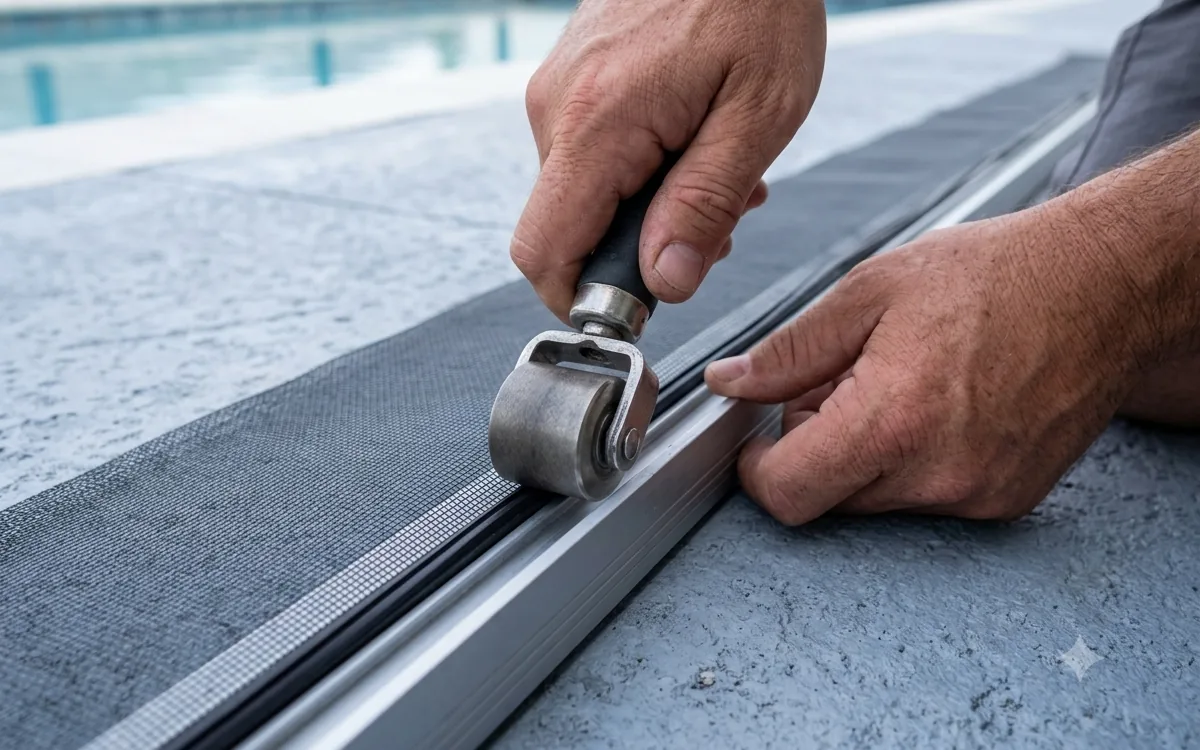
If you are being bitten inside an intact cage around dusk, standard mesh is letting biting midges through and no amount of rescreening in 18×14 will change that. The tighter 20×20 weave is the only reliable screening answer.
But it restricts airflow, and on a Florida evening airflow is much of why the space is pleasant to sit in. Insects come from a direction — the water, the wetland, the tree line. Screen the two or three walls facing that source and leave the rest standard.
Pet mesh: lower rows, not the whole wall
Pet damage happens in a band. The bottom two to three feet of panels and the area right around the door, because that is where paws, claws and shoulders make contact. Above roughly waist height a dog never touches the mesh at all.
Screening that band in pet-resistant polyester and leaving standard above it typically halves the upgrade cost while covering essentially all of the actual risk. It is the recommendation that shrinks our own invoice, and we lead with it because a homeowner who feels upsold does not call us again.
Florida Glass: the kick plate row and one wall
Florida Glass is mesh laminated to clear vinyl — no air, no insects, no splash passes through it. It belongs in exactly two places.
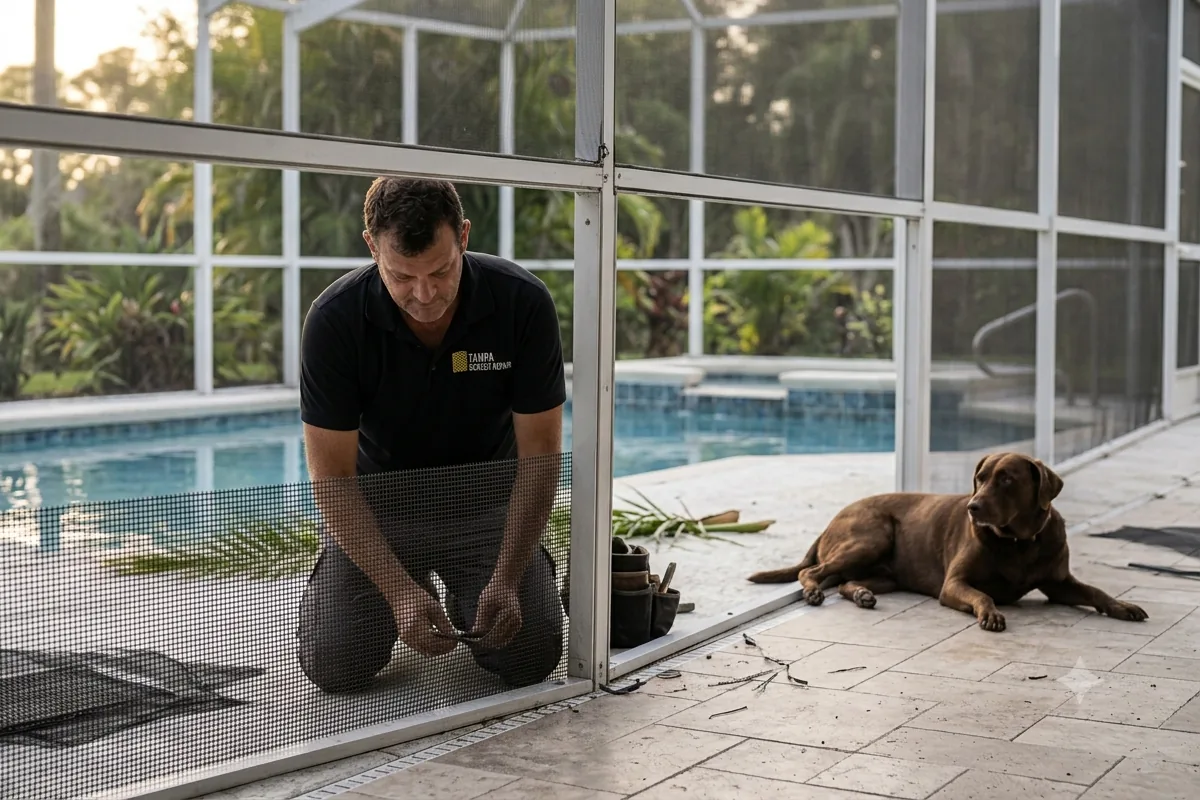
The kick plate row, because the bottom two to three feet takes all the physical abuse and none of the view. Blocking visibility at ankle height costs you nothing, and it lasts ten years plus against five to eight for the mesh it replaces.
And the one wall that catches wind-driven rain, if your cage has one. Most Tampa enclosures have a single exposure that makes the space unusable during a summer storm. Florida Glass on that wall alone fixes it. On the other three it would be the wrong product entirely, because a cage with no airflow in August is not a place anyone sits.
A worked example
A typical Riverview family cage: twenty-six panels, two dogs, backing onto a retention pond on the east side, unshaded lot.
- Roof and gables (8 panels) — standard charcoal. UV-limited, no upgrade worth paying for.
- Upper walls, north/south/west (10 panels) — standard charcoal. Nothing touches them, no insect route.
- Upper wall, east facing the pond (3 panels) — no-see-um weave. This is where the midges come from.
- Kick plate row (4 panels) — Florida Glass. Splash zone plus two dogs.
- Cage door (1 panel) — pet mesh. Highest-contact panel on the structure.
That specification costs a few hundred dollars more than an all-standard rescreen and roughly half what upgrading the whole cage to premium mesh would. Every dollar of the upgrade is aimed at a problem that actually exists on that particular cage.
What to ask for
When you get quotes, do not ask for "the good screen." Ask for a mesh specification by zone, written on the quote. Any company that works on cages regularly will have an opinion about which walls need what, and hearing them reason through it tells you a great deal about whether they looked at your enclosure or just measured it.
Questions
Related questions
For seeing out, yes, noticeably. Darker mesh absorbs incoming light rather than scattering it, so the view through it is clearer. Lighter mesh reads brighter from outside and hazier from inside. Charcoal is the standard for pool cages for exactly this reason.
Yes, and it is what we recommend on most cages. Each zone gets the product suited to its actual problem. Where two grades meet you can see the transition if you look for it, but most homeowners stop noticing within a week.
No-see-um across a full enclosure adds $400 to $950. Pet mesh across a full cage adds $600 to $1,400. Doing the targeted zones instead typically comes in at forty to fifty percent of those figures while covering the same real risk.
No, about the same, five to eight years. Both are limited by UV rather than weave density. It is an insect upgrade, not a durability upgrade, and expecting extra service life from it will disappoint you.
Standard 18x14, by a clear margin. No-see-um restricts it noticeably because the weave is tighter, pet mesh restricts it slightly because the strands are thicker, and Florida Glass stops it entirely. That is the main reason to keep standard on your upper walls.
Possibly, but positioned differently than for a dog. Cat damage is claw-driven and shows up wherever the cat can reach, which is higher than most people expect. For a persistent scratcher we suggest pet mesh further up the panel or on the whole panel at a favourite spot.
Less than you would think, because the zones follow the structure. The kick plate row already reads as a distinct band, and the transition from pet mesh to standard falls on a frame line. The only combination that looks obviously mismatched is one upgraded wall in the middle of three standard ones.
Yes. Individual panels or whole rows can be replaced with a different mesh at any time, priced per panel plus the upgrade. Trialling no-see-um on one wall before committing to three is a genuinely sensible approach.
Keep reading
More pool cage guides
Find out what your cage costs
We come out, count every panel including the roof, check the frame, and hand you a flat written price. No deposit, no obligation.
Mon–Sat 7:00am–7:00pm · Licensed & insured · Hillsborough County & south Pasco